
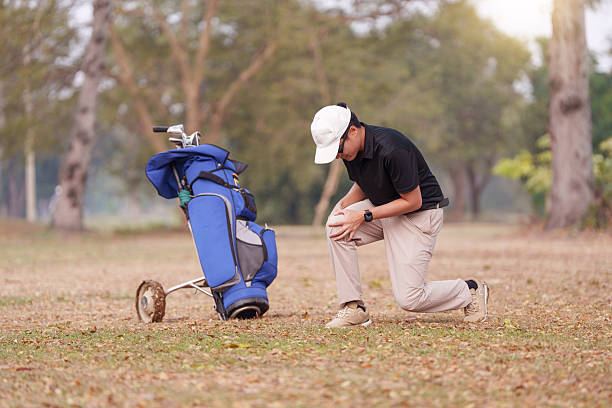
The golf swing is a rotation test your knee didn’t sign up for
A full golf swing rotates your body hard against a braced lower leg — and the lead knee absorbs a twisting, decelerating load on every single swing. Do that a few hundred times per round (plus range balls), and any weakness in the chain shows up in the same place: the knee.
Here’s the part most golfers miss: the knee is usually the victim, not the culprit. It sits between two joints that are supposed to do most of the rotating — the hip above it and the ankle below it. When those joints move well, the knee mostly hinges and transfers force. When they don’t, the knee gets asked to rotate in ways it was never designed to.
There’s never just one fix
Real golf knee pain almost always has several contributors, and an honest plan addresses all of them:
- Your swing. Swing characteristics like sliding, early extension, or a hard “post-up” on the lead leg change how much torque the knee sees. This is exactly what a TPI screen connects — what your body can’t do to what your swing does instead. Sometimes the fix is a swing adjustment with your teaching pro; sometimes it’s a physical limitation we can treat.
- What the knee itself has going on. Meniscus wear, early arthritis, or an old injury can absolutely be part of the picture — and each changes the plan.
- Load and footwear. Volume spikes (the first 36-hole weekend of spring), walking hilly courses, and worn spikes all matter.
- Strength. Glutes and quads that fatigue late in the round stop protecting the knee when you need them most.
But if you work a desk job, there are two contributors we find more often than all the others combined.
The desk-job double whammy: hips and ankles
Sit for eight hours a day and two predictable things happen: your hips lose rotation and your ankles lose flexibility. Then you head to the first tee and ask both joints for maximum range at full speed. The joint in the middle pays the bill.
Hip internal & external rotation
Tight hips prevent rotation — so all that torque gets sent straight into the knee. The backswing needs internal rotation of the trail hip; the downswing and follow-through demand internal rotation of the lead hip. Lose that motion and the rotation doesn’t disappear; it relocates, usually into the lead knee (and low back).
What we prescribe most:
- Dynamic hip openers before the round — leg swings, walking lunges with rotation, hip circles. Two minutes at the cart beats none.
- Glute foam rolling — a stiff, cranky glute complex is often what’s guarding hip rotation in the first place.
- 90/90 mobility drills — sitting with both legs at 90 degrees and transitioning side to side trains internal and external rotation together, exactly the ranges the swing uses. This is the single drill we hand out most at golf assessments.
Ankle mobility
Stiff ankles prevent proper weight transfer during the downswing — instead of the lead foot and shin accepting the shift smoothly, the movement stalls and awkward shear forces go through the knee joint. Years of desk work, old ankle sprains that were never rehabbed, and stiff dress shoes all show up here.
The test is simple: kneel facing a wall with your toes about four inches away, and try to touch your knee to the wall without your heel lifting. Can’t get there — or one side is clearly worse? Your ankles are part of your knee problem. Half-kneeling ankle rocks against a wall, done daily, is where we start.
Fix the cause, then keep the fix
This is the sequence that works: figure out where the force is coming from (assessment), restore the missing mobility (treatment and drills), strengthen the pattern so it holds up for 18 holes, and — when the body allows it — adjust the swing with your pro. Skipping to a knee brace treats the scoreboard, not the game.
If your knee is swelling, catching, locking, or painful at night, get it evaluated before any mobility program — that’s a physical therapy conversation first. If it’s the familiar ache during or after rounds, a golf-specific assessment will usually find the hip and ankle story within the first visit.
This article is general education, not individual medical advice. Michigan allows direct access to physical therapy — no referral needed to get assessed.
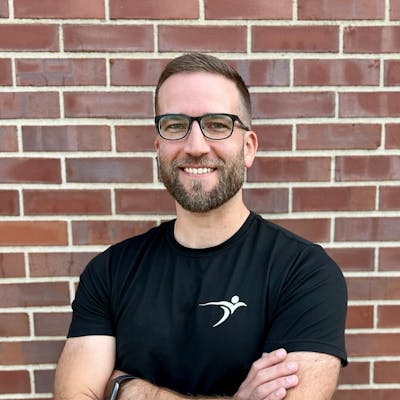
Dr. Nathan Rourke, DPT
Nathan Rourke is a Doctor of Physical Therapy (Rosalind Franklin University), Titleist Performance Institute and SuperSpeed Golf certified, and co-owner of The Therapy Institute in Haslett, Michigan, where he leads the golf performance program.
Knee pain costing you rounds?
A golf-specific assessment finds where the force is actually coming from — swing, hips, ankles, or the knee itself. Book a free discovery call and we'll point you in the right direction.
Book a Discovery Call